Friday, 16 April 2010

How do films 'The Third Man' directed by Carol Reed and 'Insomnia' directed by Erik Skjoldbjaerg use the codes and conventions of film noir?


Here is harry lime in the sewer chase scene, this is an extreme close up High angle shot of his face. In this shot he is looking up on to the road surface, showing his rejection from the city.


here is a famous scene from the sewer chase showing the stylized mise en scène of the shadows and lights in the vanishing point.


this is a very well composed Tilt shot of harry lime, as he is running away from the sounds of sirens. This shot is well composed because of the lighting of the shadows with the reflections off the road. The tilt of the shot makes the audience become disorientated and more involved with the film.


This is a shot of Harry Lime as he is lit up by a passing cars head lamps. This close up of Harry Limes face shows the light on his face where as every where else is dark. This represents the goodness of Harry Limes heart and the darkness around him is connoting the evil and how every one (apart from him and holly) see him as a criminal and a danger to society.


this is a graveyard in Vienna connoting death and has an eerie presence also giving the feel of danger.


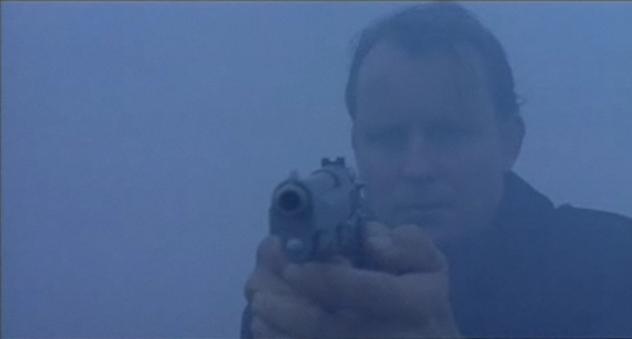
Here is Jonas ready to shoot the criminal in the heavy, heavy fog but instead he shoots his partner. This shot has a dark and gloomy colour pallet, with the gun barrel dominating the mise en scène. All these connote the darkness and the way the character Jonas gets tortured through the rest of the film to come.
Here is Jonas as he dominates the mise en scène, after shooting dead his partner. his facial expression tells a whole story of what is to come for this confused character.Here is Jonas's Partner in Jonas's arms dieing. The colour pallet in this frame is very dim again with blacks and greys dominating the mise en scène showing the bleakness of this mans future.
This screen shot taken from the cable kart scene where you can see that the other man suspects Jonas... or not suspecting but suspicious of him.
here is Tanya being filmed by what seems to be her lover but then of course she is brutally murdered. She dominates the mise en scène with the rule of thirds acting very well in this frame, as Tanya is taking up a third of the frame. the colour pallet in this frame, are much brighter and more colours involved too with the bright green of the grass and the deep blue of the sea. The colour pallet connotes the happiness of the character.


Insomnia is a Norwegian thriller film created in 1997 directed by Erik Skjoldberg. In the film Jonas Engstrom and his partner Erik Vik, investigate a murder of a young girl in Norway. You view what looks like the murder in the opening sequence. The two investigators investigate this murder, which results in a chase scene between the police and the criminal. Unfortunately there is heavy fog resulting in a mix up as Jonas shoots his partner instead of the villain. Confused Jonas doesn’t own up to this even though he knows it was an accident.

The third man a famous film noir thriller is directed by Carol Reed and is set in the city of Vienna in 1949. The character Holly Martin travels to Vienna to meet his friend Harry Lime who has a job waiting for him, when he arrives in Vienna a man greets him and informs, Carol Reed that Harry Lime is dead. As the story continues the truth is revealed about Harry Lime’s death. Harry lime turns out to have faked his death and committed a terrible crime.

In Insomnia the character Jonas must decide to admit his mistake on shooting his partner by accident. And in The Third Man, Holly Martin, meets his friend that he thought was dead, but he also knows that he is a criminal. So Holly is stuck with a dilemma similar to Jonas’s dilemma in Insomnia, where he has to decide whether to betray his best friend, or not. At the beginning of both films these characters seemed to be innocent, this gives a dark side to both characters persona.

In thriller films lighting and sound are both very important aspects. They are used to create suspense with the littlest actions in the film. The directors in the third man emphasise the impression of tension in situations. Most film noir films use strong lighting as a key for a good film showing light and dark, good and evil. The third man does, this very well and creates an ambiguity that, keeps the audience on there toes. Carol Reed uses a lot of silhouettes in the third man this connotes the confusion of the characters and the audience. As through the whole film you are never sure on who the good guy is or not. There is a scene where you first see the character Harry Lime, as he is standing in a doorway obscure from lighting so no one can see him, but then a car drives past and the headlamps glisten on the characters face. Half of his face is caught by the lighting where as the other side is still blackened, this represents the good and evil that is Harry Lime. In Insomnia, Jonas Engstrom is lit up in a similar way as Harry Lime. The Director uses this lighting effect on Jonas to imitate the mental tangle between good and evil, which affects Jonas throughout the film.

The colour pallets in the two films are very different as intently they are set in different time periods. In insomnia you can tell that its is set in a fairly modern time period as the colour pallet is greys, blacks and whites connoting technology which also connotes modern times. Where as in the third man, the colour pallet is just black and white as it is a film noir film. This just means that the film depends intensely, on the lighting in the film.

In conclusion to the question, I have distinguished that both the directors use conventions of a thriller film, to generate a refreshing piece of cinema for the masses to enjoy. Secondly both films demonstrate how an insecure and solitary character can attract any audience, grip and hold them to their seats.

Monday, 12 April 2010

Costume & Props.

Man 1 - Cameron
Man 2 - Ray
Girl - Matilda

Man 1 costume: Black leather bomber jacket
Dark jeans
Smart black shoes or Dark trainers
Scruffy hair


Man 2 costume: Black mack/anorack/coat
Dark Trousers
Smart black shoes
Black trilby hat


Girl costume: Summer dress in bright colours
Long coat
Small pump shoes
Scarf


Props

Two brown parcel bags

Two/Three family photos


A bag of herbs/spices – supposed drugs

by Jasmine Dinnage & Finbarr Pine

The Music.

the music was found by Jasmine Dinnage

'I found 2 of the pieces of music that we are using on freesound.org this website has a range of sound effects which we were able to use.
They music is part of the Creative Commons Sampling License.
This means we are allowed to use the music for sampling and creative transformations. This also means that we are allowed to distribute our film with this music for noncommercial purposes.'

Film Title.

Our Film is called Ricochet because our film flashes back and forth between the past and the future, but also between the different views of all the characters. It also helps show the differences and similarities of each characters nature.

Shot List.


1. Shot one black screen of Gareth talking about eerie and suspicious things.

2. Establishing - Long - panning shot of the market and at the end of the pan zooms in to a clock tower.

3. Cuts to black ‘heart beat’

4. Cuts to a eerie street lamp and slowly zooms out to see Cameron walk past the camera

5. Medium panning shot of Cameron turning the corner in to the marketplace

6. Medium panning Shot of Gareth passing the package 1 to man 1

7. Cameron walks in to camera – camera cuts.

8. Medium panning shot of Gareth handing over package and saying ‘Here is the item.’

9. A long panning shot of the girl walking over the bridge.

10. A close up of her face as she walks along a street (camera should be over the other side of the road as cars in the foreground seem to automatically cut.)

11. Then a close up of man 1 getting out of a taxi out side the train station (shot should be from out side the taxi, looking in to the taxi at man 1’s face as he gets out.)

12. Long shot of man 1 getting out of the car and girl can be seen in the back ground (within this shot man 1 walks in to the camera to cut.

13. Medium pan Shot of man 2 as he faces towards the girl walking towards the train station.

14. Establishing long shot that starts in the roof of the train station and pans down to an empty seat that the young girl comes and sits on as soon as the camera is still.

15. Camera pans very quickly after the young girl looks towards the left as man 1 walks in to the frame.

16. The camera zooms in with the gaining distance of man 1 walking off to look at the clock and move to the right back in to the young girls view.

17. Cuts to black (credits)

18. Close up of the near side of the young girls face (still sitting) with man 1 in the background walking towards the young girl / exit of the train station.

19. Close up of the girl standing up almost in to man 1 as he walks near.

20. Medium shot from the other side as the hit in to each other and both let go of their packages.

21. Close up of the packages hitting the floor, and the two characters picking the wrong ones up.

22. Close zoom out shot of man 2 standing and looking shiftily around the exit of the train station. (Zoom out until you can see the young girl walking towards the exit/ man 2)

23. Close up of the two characters knocking shoulders

24. Extreme close up of the two characters faces (eye to eye)

25. Close up of the Characters walk away from each other (shot should be from the other side as the young girl walks in to the camera as it cuts.

26. Cuts to black (with credits)

27. Medium shot of man 2 tapping man 1 on the shoulder and taking the package. (Shot from behind the two men.

28. Close up of the package being opened by man 2, from the front (slow zoom out to view both the characters watching.

29. Cuts to an extreme close up of the package being opened from above/ in-between the two characters,

30. A close up of a photograph being pulled out of the package from the front slowly zooming in to an extreme close up of the face on the photograph (should be a recognisable photo of the young girl in the film)

31. Panning shot of the two characters debating what has happened to the original package.

32. Over the shoulder shot of man 2 talking to man 1

33. Over the shoulder shot of man 1 talking to man 2

34. Zoom in to man 2’s face. As he finishes the conversation. (Medium shot to a close shot)

35. Cuts to a shot of man 1 looking in to the ceiling of the room in disbelief.

36. Flashes of stills of the last minute of film

37. Shot of the two men realising the photos that they possess are of the person who they have both seen and recognise (this should be a medium 2 shot of both the characters realising this and both looking over there shoulders towards the exit of the train station.)

38. Black screen that flickers the word ricochet.


Shot list: By Finbarr Pine.

Monday, 29 March 2010

Matilda - is our young girl character that gets mixed up with the wrong people in our film. we have used this actor as she comes across as a venerable young girl who could be in danger. which is exactly what we wanted for this part.
Gareth - this actor we found on a local market who owns this spice store that is very eerie and comes across as a actor that would think he is above the law.

David Martin Hill - this actor we used because he is a very mysterious looking man, and easierly represented as eerie.


Cameron Button - is our final character and is one of the main ones. He is very weary of what he is doing and is always watching what he is doing. This brings a whole new level of nervousness and weariness to the audience.


Sunday, 28 March 2010

Digital Screen Network

What is digital screen network?

A £12 million investment to equip 240 screens in 210 cinemas across the UK with digital projection technology to give UK audiences much greater choice.

How can it help inderpendant producers and exhibitors like picturehouse?

Because it allows exibitors like picturehouse to have a wider range of films as they do not cost as much. Digital screening cuts the cost of releasing films. (a digital copy costs around one tenth of a 35mm print). Also the quality of the films when copied from the original source never fades.

What will it mean for audiences?

It means that audiences will be able to go and see more films at the same cinemas as the prices will be reduced as the film cost is a lot less than it is on a film real.

How does it impact on YOUR film consumption?

It lets me view a wide range of films, and a lot more frequently as the prices of viewing films would be cheaper. I would also then be able to see independent films that I might not have been able to view before.

What will this technology also provide cinemas? (audiences/alternative viewing)

This technology will bring in bigger audiences and therefore larger profits and a wider varied audience.

What can you suggest this might mean for other technologies?

The technologies used before digital networking such as a film reels as hardly any films are created on it anymore and therefore not used as much.